
What Is Greensand?
Greensand is an excellent organic soil amendment that provides over 70 trace minerals and micro-nutrients not commonly found in Florida's sandy soils.
It is meant to supplement our general plant food amendments, and not meant to be used alone, as it does not contain a substantial balance of the major NPK elements.
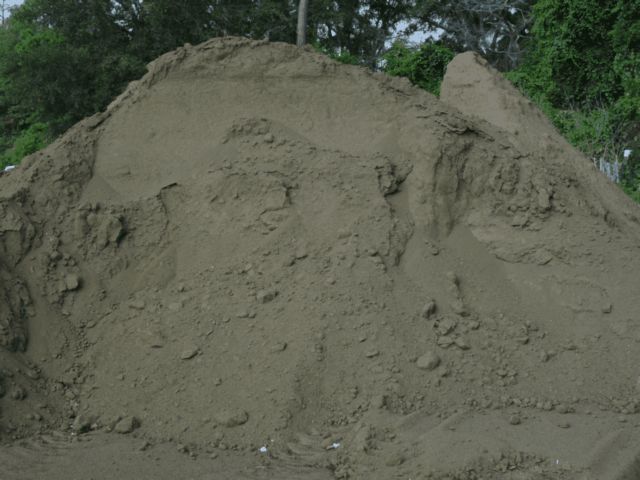
pile of freshly mined greensand
photo courtesy of Nature's Way Resources
Where Does It Come From?
Greensand is mined from a sedimentary rock called "Glauconite", a natural geologic deposit formed from ancient sea beds. Think kelp, seaweed, algae and ancient marine life fossils, decomposing for many centuries. It is an olive-green color and turns a dark grey-green when wet. When dry, it has a consistency of sand and mixes easily with other organic soil amendments.
Glauconite deposits have been found all over the world, though mostly in the US & Great Britain. In the US, it has been mined in PA/NJ, in TX, and in Arkansas. It is also found in Delaware, Maryland and Virginia. Even Florida had a mine in the early 20th century.
Benefits: What Does It Do?
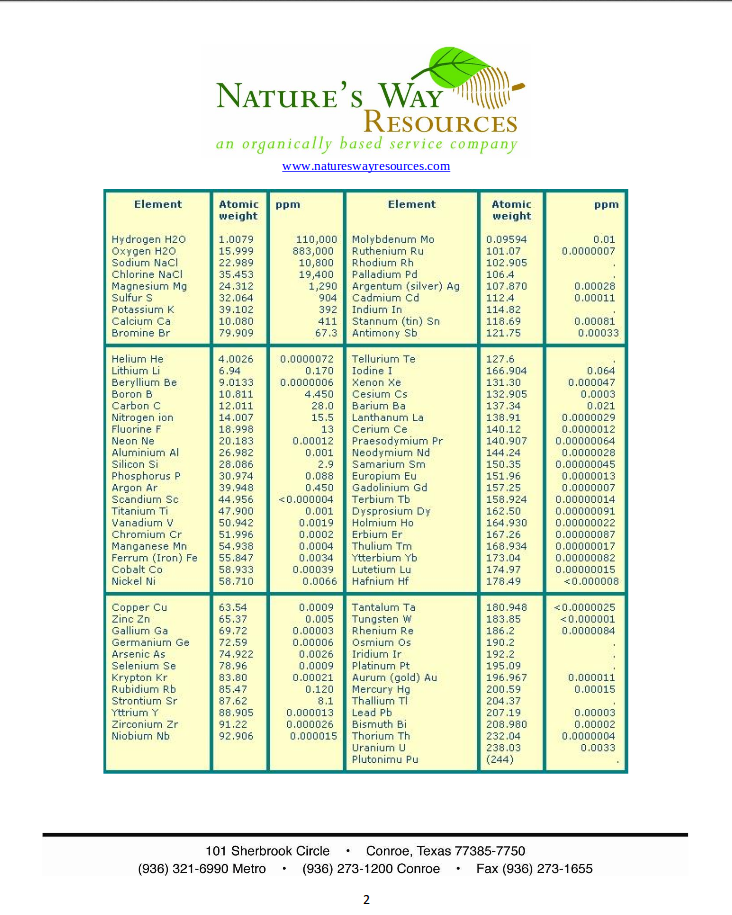
While Greensand has been used for over 300 years as a soil amendment in the US, there is a lack of adequate scientific research to explain what numerous greenhouse and field studies have shown. Most scientists are so focused on the soil conditioning aspects of greensand, that they fail to recognize the nutritional value of the 70+ trace minerals and micro-nutrients it contains.
Hence, a bag of greensand will typically list a handful of nutrients, touting the potash, potassium, and iron content, but fails to mention the 30+ trace minerals and the other 40+ micro nutrients that are the most important aspects of Greensand! But greensand is nothing short of amazing for supplementing the soil with minor, micro, trace and pico nutrients.
The minerals found in greensand are normally released slowly into the soils. However, when added to organic rich soils, the beneficial microbes cause the minerals to be released faster, making them more bio-available to the plants.
The pH of greensand can vary from slightly acidic to slightly alkaline, and just like wood ashes has very little affect on the soils.
What's the big deal about trace minerals?
Recent studies reveal that it is the trace minerals such as found in greensand, that enable the plants to more effectively transport nutrients from roots to leaf tips, strengthening the plant against disease. So the plants not only grow better or bigger with greensand, but it significantly strengthens the plant's immune system.
It also improves the flavor and nutritional value of fruits and vegetables. I can tell you from personal observation, even the deer will ALWAYS choose the plants that have been fed with greensand and other organic soil amendments over even their "preferred favorites" menu grown synthetically!
Research shows that a lack of these 70+ elements leads to more insect and disease problems in plants and the living beings that eat them.

... it is the trace minerals that enable the plants to more effectively transport nutrients from roots to leaf tips, strengthening the plant against disease
Recent studies reveal !

The 20th Century' "16-17 essential nutrients" model for plant development has become obsolete.
Research Shows that!
The 20th Century' '16-17 essential nutrients' model for plant health has become obsolete. It is quickly being replaced by an understanding that many more micro & trace nutrients are necessary for enzyme production and general immune system development.
Why is the "iron" and "potassium" on
the label NOT the big deal?
Iron content can vary from 12-19%, and often is released so slowly that we need additional iron supplementation in Florida to get past the calcium in our water.
Potassium varies typically from 5-7% and is also released so slowly that it is insufficient as a sole source of potassium. But because it is a slow release product, greensand does not burn.
Other Benefits
Greensand is a great soil conditioner, improving the moisture holding properties of soil, as it is capable of absorbing 10 times more moisture than most soil. It loosens hard soils, and binds sandy soils and assists in the release of other nutrients.
We also know that mineralization can improve soil life by increasing certain bacteria that can slowly dissolve insoluble mineral nutrients, making them more bio-available.
While the pH will vary some from slightly acidic to slightly alkaline, it makes little effect in the overall pH balance of the soil.
Concluding thoughts.
Traditional soil science has taught that plants can grow with only 16-17 elements. But recent research has shown that when plants are provided with a lot more selection of the trace, minor and macro nutrients, they have less disease and insect problems, grow bigger, more fragrant flowers, more tasty fruits, etc.
And a little food for thought: The human body has 90-something elements in it: if they are not in the soil for the plants to use, how can we replace them in our bodies from our food supply?
Order Greensand Here:
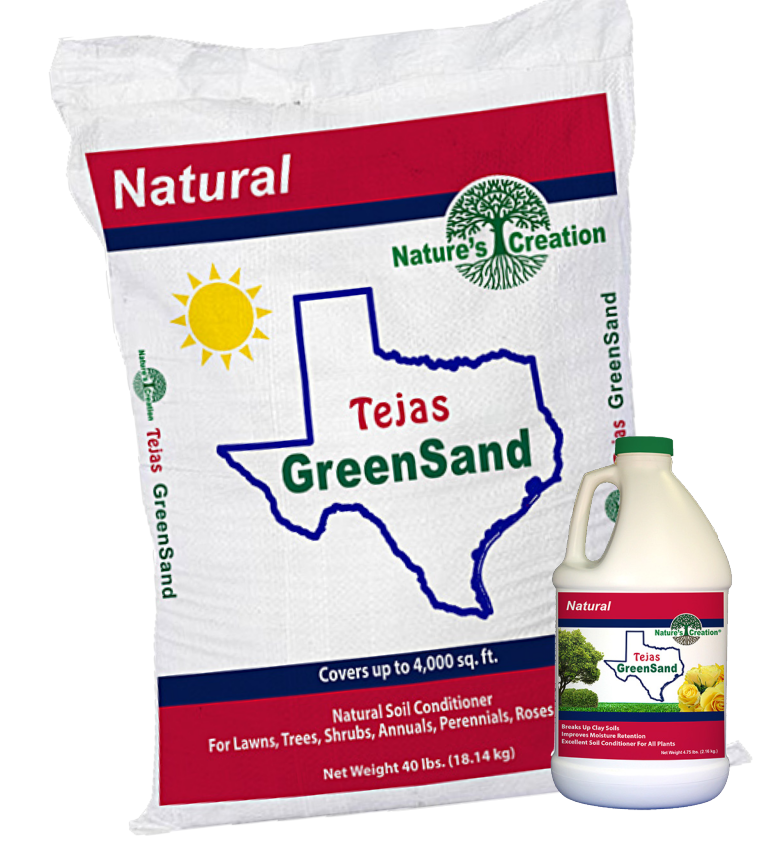
Greensand: available in 40lb bags for $40.
comes packaged in heavy plastic to withstand the elements in storage. Pick up at the nursery or have it delivered with your tree order. If choosing delivery, but no trees, $35 delivery charge will apply.
No shipping via third party carriers: no exceptions.
A Little History About Greensand mining in the US & North America
Glauconite deposits known as "Jersey greensand marls" in southern New Jersey were heavily mined in the late 1700's and mid 1800's as a source of fertilizer for nearby farms.
In fact, the world's first nearly complete dinosaur skeleton --- "Foulke's bulky lizard" -- was found in a glauconite mine in Haddonfield New Jersey. It was put on display at the Philadelphia Academy of Sciences.
Ref:
(1) https://geologymuseum.rutgers.edu/about-us-geology-museum/mastodon-musings/mastodon-musings/255-the-story-of-new-jersey-s-state-fossil-hadrosaurus-foulkii
(2) https://www.foulke.org/history/essays/dinosaur.shtml
(3) https://podcasts.apple.com/us/podcast/new-jerseys-dinosaur-the-hadrosaurus-foulkii/id1576266622?i=1000544285413
Greensand in Canada:
In 2011, a group of scientists wrote about a tremendous huge stash discovered in the Sverdrup Basin, Artic Canada:
read here: https://geoconvention.com/wp-content/uploads/abstracts/2011/320-Iron_from_Land.pdf
or click here to download pdf.
Greensand in Australia:
Even Australia has found glauconite deposits to explore:
(This page is no longer on the Internet as of 2025, but you can click here to read the story.)
A quality greensand product will contain at least 90% of the mineral glauconite, and less than 3% of clay minerals.
For Further Reading:
Comprehensive Chemistry of Select Greensand from the NJ Coastal Plains (1998) by John H Dooley:
http://www.state.nj.us/dep/njgs/pricelst/tmemo/tm98-1.pdf
The Handbook of Texas:
Texas has a lot of greensand deposits: search for greensand at this link to see the vast number of deposits: