
Growing Blueberries in FL
Made Easy
Rabbiteyes & Southern Highbush are the 2 varieties of choice for growing in Florida. Most commercial groves in the state have transitioned to growing Southern Highbush. But home growers in the northern parts of Florida will find Rabbiteyes easier to grow.
Here in North Central Florida, we are at the southern tip of the growing range for Rabbiteyes. This means that commercial growers further north of us have an easier experience than us because they have a little more chill.


And we are at the northern tip of the growing range for Southern Highbush. This means they are easier to grow a little further south without the risks of a late frost. Yet we have a lot of u-pick blueberry farms in North Florida!
So what should the homeowner grow?
Overall, the Rabbiteyes will take less work if you live in Ocala or north on the east side of I-75, and Brooksville and north if you live on the west side of I-75. And you'll have a much bigger harvest from Southern Highbush if you either live in a warm pocket or closer to Orlando or Tampa. Or you find ways to protect from freezing in January and February after blossoms have set.
Rabbiteyes will need two for pollination.
Southern Highbush are often self fertile, though growing 2 kinds is always helpful for maximum pollination. Especially important if you are growing commercially.
SOIL RECOMMENDATIONS
pH is critical:
Blueberries must have an acidic environment, best in the range of 5-5.2 pH, though 4.5-5.5 is tolerable. Pine needles and pine bark mulch are very helpful, mixed with decomposed organic matter and peat moss, but sometimes not enough.
Elemental sulfur can be added to bring the pH down. Some growers suggest amending with 1/2 lb of sulfur per cubic foot of soil as a general rule of thumb: but test your pH and add gradually, preferably a few months in advance of planting.
When the pH is higher than 5.5, blueberries are not able to use the available nitrogen and leaves will turn yellow.


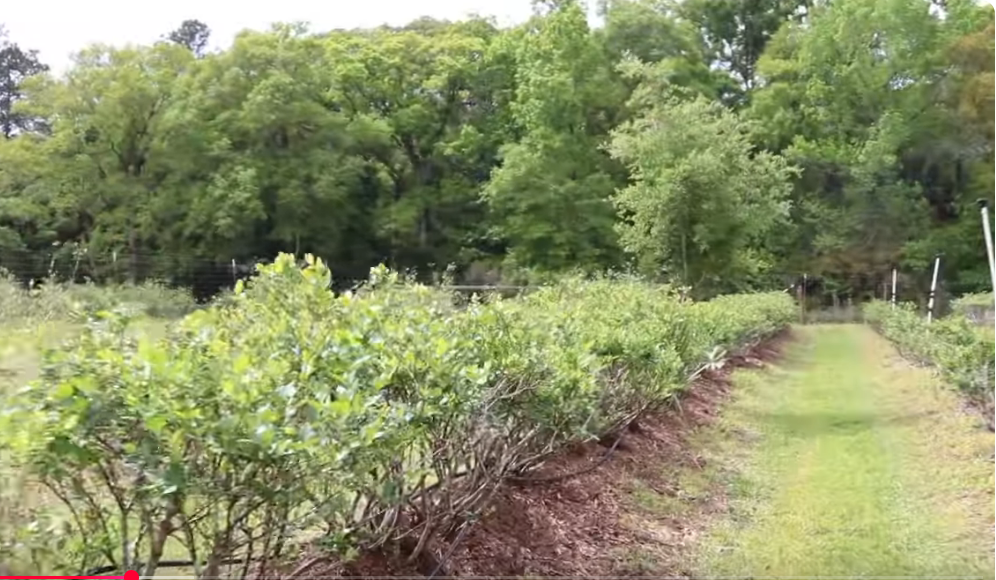
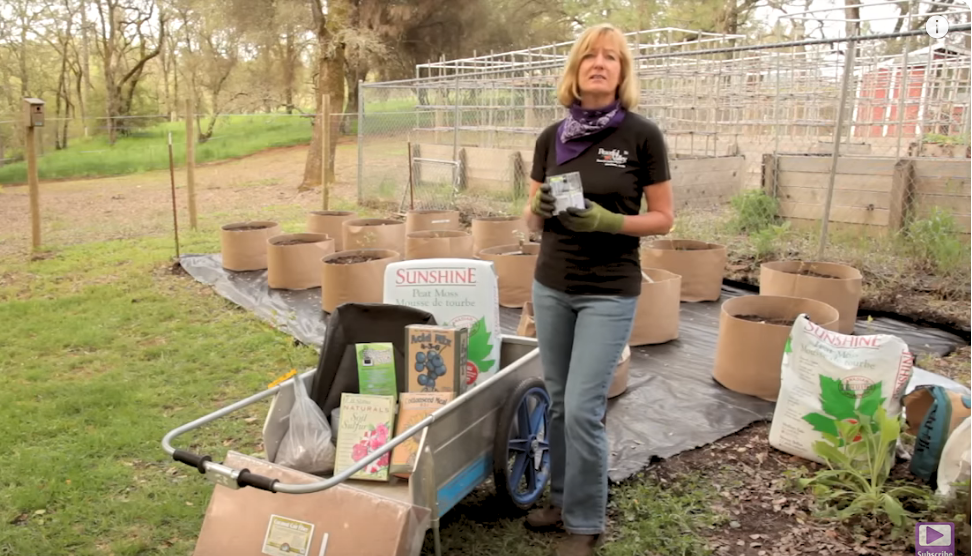
container growing is an option
Planting Habitat:
Blueberries have shallow roots, so planting in elevated beds, large pots, or simply planting in rows on top of the existing soil level is an effective means of controlling their pH environment. It also helps with water drainage control as discussed next.
Water:
Because of the shallow roots and the need for well drained soil, care must be taken to provide consistent moisture such as from drip irrigation or a soaker hose.
Blueberries do not tolerate drought. Adding peat to the soil before planting will help retain moisture.
Since we also get monsoons in addition to drought conditions, it is best to plant the blueberries in a mounded row so they have excellent drainage. They need at least 18" of good drainage to prevent root rot.
Irrigation:
Irrigation is a must. Blueberries do not want to be bone dry. If kept slightly moist they will grow much faster and produce more fruits. Drip irrigation can be as simple as polypipe running the length of the rows with 1 or 2 emitters at each plant. Watch for signs of a clogged emitter. Since blueberries have a shallow root system, 10-15 minutes once every few days during the drought season may be all that is needed.
FEEDING BLUEBERRIES:
Professsional growers use several different fertilization theories for blueberry production: winter-dormancy vs evergreen production, and each with and without the use of hydrogen cyanamide (Dormex) to force a timed break from dormancy. In areas of Florida with February freezes, Southern Highbush crops are protected from frost either by overhead irrigation or growing in tunnels.
Rabbiteyes typically are not as demanding as Southern Highbush. When using organics, feeding your rabbiteye bushes every 6-8 weeks should be enough. Blueberries thrive best with plenty of trace minerals such as found in the BioTone or our magic mix formula. Extra humic acid (liquid spray) in the first 2 years will help establish the soil microbials for optimum growth. Spray both the plant and the soil.
Southern Highbush are heavier feeders. They like to be fed every 3 weeks. But then they are also heavier producers for a smaller plant too!

SPACING
Rabbiteyes are larger and need more space than Southern Highbush. If grown in rows, leave 12' between rows, center to center, and plant the bushes approximately 6' apart. This translates to about 5-600 bushes per acre, giving them plenty of space to get air and sunshine around each bush. If growing in large cloth air bags, 30g bags can be placed on 6' centers overall.
Southern Highbush can be planted 4-5' apart in rows that are as close as 8' apart, unless you want more space to drive between rows. The closer planting means about 2000 plants per acre.
YIELD:
Rabbiteyes won't set maximum yields in Florida. So while some websites will tell you 10-15 lbs per bush is common, expect something more like 3-5 lbs per bush in North Central Florida. It's an artifact of how many chill hours it gets: on a colder winter at 400 chill hours we will have a heavier harvest if we don't have a late freeze.
Southern Highbush average about 5 lbs per plant on a three year old bush. So if you have 2000 plants per acre, that's about 10,000 lbs of fruit per acre! Some of the newer cultivars have even higher yields, up to 25,000 lbs under ideal conditions.


PRUNING:
Blueberries should be pruned when dormant, annually. Early January is a good time in Florida.
Rabbiteyes need intentional pruning, artfully cutting out the older branches and any dead wood. If you select about 20 percent of the bush to trim each year, you never have growth older than 5 years old. The newer growth is far less prone to fungi issues and disease, so this prolongs the productivity of your grove.
Annual pruning helps maintain consistent yields. Skipping pruning for several years followed by heavily pruning, later leaves you with too many canes that become unproductive all at once.
Left unpruned, Rabbiteyes can grow up to 20' tall, leaving the berries out of reach.
Southern Highbush on the other hand are easier to prune. Most growers just arbitrarily top them off at about 24-30" high every winter and let them re-grow.
LIFESPAN:
Rabbiteyes can live for several decades. 25 to 50 years is not uncommon in commercial orchards.
Southern Highbush typically only produce for 8-12 years maximum.