
Does SOAP Really grow on Trees?
Why yes, actually it does!
While scientifically classified as a nut tree, let me be insanely clear here: Soapberry is NOT an edible nut. Parts of the tree are toxic to humans if injested.
Now, that said, here's what is tremendously useful about these trees: the hulls of the nut contain a soapy substance that acts like, feels like, and is, well, an all natural (non-chemical) supply of clean soap!
Sapindus is a genus of about 12 different members of the soapberry family Sapindaceae. Some are deciduous and some are evergreen.
All are toxic and not for internal consumption. All contain a saponin-rich soapy substance which can be used as soap, hence the common name soapberry or soapnuts.
There are 3 species of soapberry plant commonly found in the continental US:
Western Soapberry: Sapindus drummondii
Florida Soapberry: Sapindus marginatus
Wingleaf Soapberry: Sapindus saponaria
Western Soapberry is the most cold hardy, but is not salt spray tolerant. It grows in zones 6-9 and is widely found in the mid-west and southwest US. It is deciduous. Grows 20-50' tall.
Spreads by underground rhyzomes in addition to seeds.
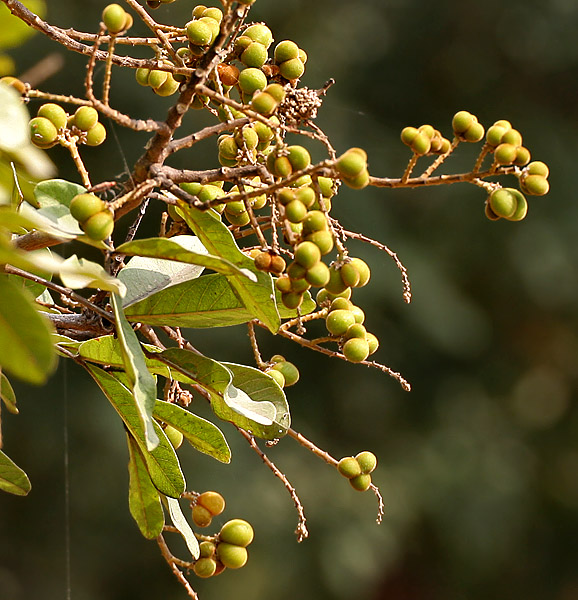
photo courtesy of wikipedia
Wingleaf soapberry is primarily grown in the Florida Keys, Carribean, and Central America, and is suited best to zones 10-12 only. It is more or less an evergreen in those areas. Grows 20-40' tall.
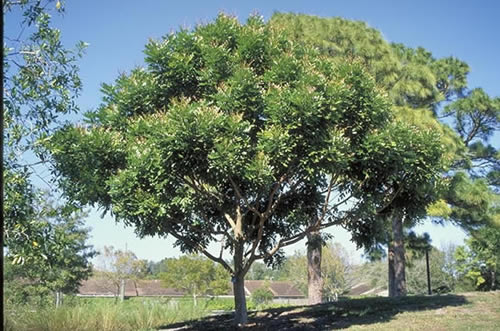
photo courtesy of IFAS
Florida Soapberry
Sapindus marginatus
Florida Soapberry is actually native to Florida! It is grown from Florida to South Carolina, zones 8-9 primarily. It is deciduous. Grows 20-40' tall.
The common name 'Florida Soapberry' also loosely refers to both the Winged soapberry (S saponaria) and the non-winged species (S marginatus) but is more appropriately assigned to just the non-winged species, Sapindus marginatus.
It should be noted that some botanists consider the Sapindus Marginatus to be the same species as the Sapindus Saponaria.
Soap Nut trees love full sun to partial sun the best. They do not grow well in full shade.
While they are tolerant of most any kind of soil, even poor soil, they thrive best in fertile, nutrient-rich soil. They prefer a slightly acidic pH, 6.0 to 6.8. Seedling trees take approximately 9-10 years to bear.
Soap Nuts bear a strange resemblance to pecan trees, except a lot shorter at maturity. Left un-pruned, soap nuts grow to 20-40' tall, whereas pecans get 75-100' tall. The cooler the climate, the shorter the tree. They can be propagated by seed or by stem cuttings.
So while the soap from soapberries won't lather up as sudzy as commercial chemically made soaps, it cleans just as well and doesn't introduce poisons to the skin. Makes a luscious shampoo that really pampers your hair!
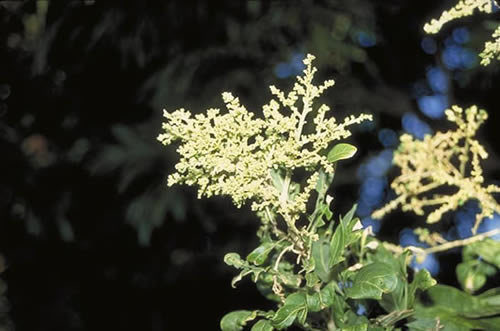
soapberry flowers
Soap Berry Trees
for external use only:
makes great shampoo
NOT FOR INTERNAL CONSUMPTION !