
HOW TO GROW BANANA TREES
If you live in Central or even North Central Florida (zone 9), it is possible to grow bananas outside. But since we do see a little frost -- or even a lot of frost in the northern parts of zone 9, you'll need to plant where your banana tree has some advantages.
Bananas can be grown outdoors as far north as zone 8. They will take a little work if you want to have a crop in zones 8 or 9. You'll need some mega nutrition and a little frost protection techniques.
Banana species
Most cultivated bananas are actually hybrids between two wild species, Musa acuminata and Musa balbisiana. Wild species of bananas have seeds. Cultivated bananas are almost always seedless, so they have to be propagated vegetatively. The most common propagative method is rhizome division, though tissue culture is also used.
Names can be highly confusing. Within a single country, the same species of banana can have many synonyms. For example, 'Dwarf Cavendish' has 58 different synonyms across 29 different countries or geographical areas. And 'Lady Fingers' is used to refer to many different baby sized bananas.

To purchase banana plants, click here.

To purchase banana plants, click here.
Growing environment
Bananas can be grown in full sun to even partial shade, though they fruit more heavily in full sun.
Rule of thumb on a banana plant: you need 12 leaves before the plant will flower and fruit. So the trick is to protect from freezing enough that you can start spring with at least 3-4 leaves, or at least 4' of trunk.
Plant on the south side of your house, or where ever green trees or a hedge blocks the cold north winds from hitting your bananas.
You can create a fast growing 'hedge' windbreak by planting seedling loquats and pruning the tops off to create a multi-trunk, bushy plant, 8-10' tall.
And don't plant down in the valley if your place is hilly: even though that's good for retaining moisture, that's where the cold settles on frosty nights. Plant halfway up the hill so you're not in the cold valley, but not on the windy hill either.
You may also need to wrap the 'trunk' of the banana plant for cold weather. A thick horse blanket with hay on the inside is quite effective. That way you start with 4-5' of 'trunk' in the spring, not at ground level.
Peat moss added to your soil when planting is helpful for bananas as they like to stay moist. Peat retains up to 20x's its weight in moisture and mixes well with composted dirt to make a loamy planting medium. Do not use straight: it will create an impervious crusty layer on top of the soil.
Vermiculite also retains water, but it can raise the soil pH slightly, which may not be desired for some plants. And since it never breaks down, we question the wisdom of adding this mix of hydrated laminar minerals (aluminum-iron-magnesium silicates) to our garden top soil everywhere.
Also, bananas like a lot of nutrition: they are total nitrogen hogs. While you might only fertilize the rest of the garden every 2 months, feed a banana plant every month. Organic, animal manure compost is excellent here. We have a lot of success with using soil amendments -- organic composted chicken manure, greensand, wood ashes, Dr Iron, and Epsom Salts.
Ask us about our Magic Mix formula: trace minerals are key to robust flavor and sweetness.
If using liquid organic fertilizers, apply 3x's/wk, every week for faster growth. The sooner you get those 12 leaves, the more chance of fruit at the end of the year.
Bananas add a new leaf about every 17-18 days. But they lose one leaf about every 4-5 weeks as well. So do the math: you must get 12 leaves by Sept 1 to get fruit before frost!
It takes approximately four months for the flowers to turn into ripe fruit. You want to see those flowers starting in September to harvest fruit by December.
Fruit ripens from the base to the top of the cluster.
To purchase banana plants, click here.
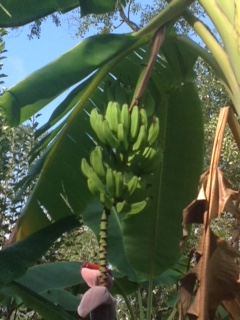
Success with bananas in Live Oak, Florida !!!
Diseases
Because cultivated bananas are propagated by vegetative reproduction (i.e. rhizome division) rather than sexual reproduction (e.g. seeds), they are essentially clones of the parent plant, genetically identical and do not evolve disease resistance like a seed propagated species does.
This makes it convenient for commercial growers to produce a consistent product, but leaves the species vulnerable to disease wipeout.
So be environmentally responsible, and keep your PCO Choic cedar oil or Organocide® 3-in-1 Garden Spray handy as an organic fungicide, should problems arise.
PANAMA DISEASE
Panama disease is a fancy name for Fusarium wilt, caused by the fungal pathogen Fusarium oxysporum. The fungi enters the plant's roots and spreads throughout. The first symptom is irregular yellowing of older leaves. The fungus disrupts the plants vascular system, so eventually the plant dies from dehydration.
It attacked the commercially popular 'Gros Michel' bananas in the late 1940's, nearly wiping out commercial banana production until growers could re-plant other varieties.
The disease is not a threat to humans, and is not yet present in the Americas or western Africa. It has spread worldwide otherwise, and does effect some of the Cavendish crop in Malaysia, Pakistan, Philippines, and Indonesia. It is also on the rise in parts of Africa and Australia.
Interesting Historical Tidbits
BANANAS are an evergreen perennial in tropical zones, and most die back to the trunk or even the roots in colder sub-tropical regions. It is technically not a tree but an herb plant, belonging to the genus 'Musa'.
The trunk, more properly called a pseudostem, consists of tightly packed layers of leaf sheaths emerging from completely or partially buried corms.
Both male and female flowers are present in a single inflorescence, making the banana plant self fertile. The seeds in the Musa acuminata Cavendish varieties are so small they are mere black specks in the center of the fruit, making them highly desirable for eating.
Genus 'Musa' gets a name
The genus 'Musa' was named in 1753 for Antonius Musa, physician to the Emperor of Rome, Octavius Augustus 63BC-AD14. Musa acuminata is a species of banana native to Southeast Asia. Most of our modern day dessert bananas belong to this subspecies, although a few are hybrids with Musa balbisiana.
Origination of
'Cavendish' bananas
CAVENDISH BANANAS were named after the Duke of Devonshire, William Cavendish, in 1834 England. He had received a shipment as a gift from the chaplain of Alton Towers (also in England), the garden estate of the Earls of Shrewsbury.
Cavendish's gardener, Sir Joseph Paxton cultivated them in greenhouses and botanically named them Musa cavendishii, after the Duke. From there, they were re-distributed around the Pacific in the 1850's. They were also referred to as "Chatsworth bananas" from the name of the Duke's estate, 'Chatsworth House'.
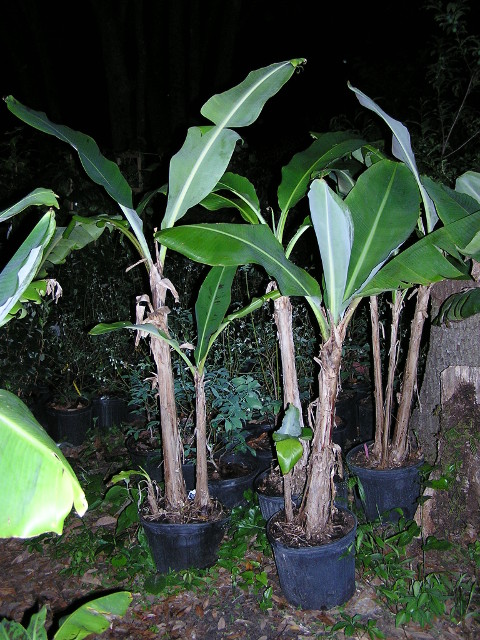
large Dwarf Cavendish
By 1903, Cavendish bananas entered mass commercial production. It wasn't until the 1950's that the Cavendish gained prominence, after the "Gros Michel" succumbed to 'Panama disease'.