
My Citrus Leaves Look Like This: Is it nutrient deficiency, bugs or a disease?
Diagnosing what's wrong is a complex science --- and while we leave the hardest situations to the experts with sophisticated tests to prove or disprove diagnosis, we'll discuss a few basics here to address some common problems with nurturing citrus that can be done with a sight evaluation.
It is worthy to mention that research has found that urea based fertilizers can contain Biuret which is toxic to citrus and causes trace mineral deficiencies. Read more on this subject here.
(UPDATE 2025: original study on Biuret referenced above was found here: http://citrusresearch.org/wp-content/uploads/Crowley_David_Macronutrients_theirrollcitrus.pdf but has been removed from the web.)

meyer lemon blooms
Part 1: NUTRIENT DEFICIENCIES
First, let's look at some common signs of mal-nutrition or what we call deficiencies. You can often stave off both bugs and disease simply by keeping your trees well fed.
We'll discuss the bugs and disease issues in another post, for Part 2 & Part 3.
Nitrogen deficiency:
Nitrogen deficiency is the most common deficiency if you're not feeding your trees or there's been too much rain. Foliage is pale overall like this:

whole leaf chlorosis caused by nitrogen deficiency
photo courtesy of idtools.org (a product of the USDA)
Deficiency symptoms are easily confused with Huanglongbing (greening), citrus varigated chlorosis (CVC), and/or psorosis (see photo at left).
The best way to cure nitrogen deficiency is small animal manures to jump-start the nitrogen building in the soil. Get the soil teaming with the right microbes, and the nitrogen-fixing bacterias will do the rest --- the natural, organic way without producing chemical run-off to kill our streams and waterways.
No, it's not the fastest process, but it has the most longevity, is the more sustainable, and has the least side effects if any.
Magnesium deficiency:
Magnesium is moved from old leaves to new growth and developing fruit, so if there's not enough to go around, the old leaves will show signs first.
Foliage turns yellow on the edges first, leaving a v-shape of green at the base of the leaf.
And while it occurs at any pH, it is more likely to occur if the soil is too acidic. The singular remedy is Epsom salts.
Magnesium deficiency symptoms will show up in the old leaves first, because the plant sends its available magnesium to the new growth and developing fruit.

leaf chlorosis caused by magnesium deficiency
(a research tool of the USDA)

photo courtesy of edis.ifas.ufl.edu
Iron deficiency:
Iron deficiency produces pale leaves, but notice the veins stay dark:

classic iron deficiency
photo courtesy of edis.ifas.ufl.edu
Iron deficiencies show up more often in the fall months, after our summer rains.
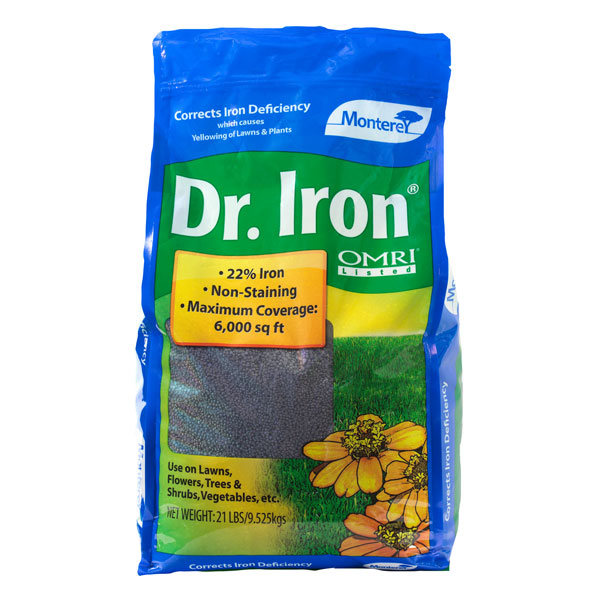
Dr Iron is an OMRI-listed (organic) source of iron. A little goes a long ways.
Manganese deficiency
This one gets harder to distinguish. Notice the leaves are yellowish overall, but the larger veins are still somewhat green. Overall looks kinda mottled.
Sometimes confused with either zinc deficiency or nitrogen deficiency. Sometimes confused with greening because the symmetry is less obvious, but there is still more patterning than greening.
Often shows up by late spring / early summer, and after major rainy season.

manganese in citrus leaves appears as broad pale areas between green veins causing foliage when viewed from a distance to have a mottled appearance overall
photo courtesy of University of CA
TIP:
If your palm trees planted nearby also show frizzle on new growth instead of robust leaves, that's manganese deficiency too and may help you make the determination more easily.

manganese deficiency is particularly evident in the spring after a cold winter
photo courtesy of edis.ifas.ufl.edu
TIP:
Notice in these two photos that the length of time since onset determines just how pale your leaves look.
Zinc deficiency
The chlorosis gets creative patterns between veins, and leaves may be smaller than normal. Until it gets severe, it can be hard to distinguish from other deficiencies.
If you're using the greensand in your mix (not exclusively but as part of your protocols), you are far less likely to see individual trace mineral deficiencies like zinc.

photo courtesy of idtools.org

photo courtesy of edis.ifas.ufl.edu
Boron deficiency
... is characterized by raised veins and discoloration of the leaves. Much of Florida's soils are low in boron. It is also easily leeched by rain. Not talked about as much, but rather common in FL.
Boron deficiency also shows up inside the fruit as brown spots in the white pulp next to the rind like you see in this grapefruit, as well as lumps on the outside:

grapefruit rind showing boron deficiency

And this is boron toxicity: remedy by adding more nitrogen

photo courtesy of idtools.org
Boron deficiency also causes corking, thickening of the leaves, tendency of the leaves to curl downward:

leaves with boron deficiency

photo courtesy of citrusresearch.org
Here's a great comparison of 6 conditions side-by-side:

photo courtesy of citrusresearch.org

photo courtesy of citrusresearch.org
check this out: problems come in threes !
photo at left shows 3 deficiencies in the same citrus tree: low iron, low manganese and low zinc; tree was growing in too alkaline conditions: highly calcareous soils.
Additional references:
https://edis.ifas.ufl.edu/hs141#FIGURE%2060
https://www.burkesbackyard.com.au/fact-sheets/in-the-garden/gardening-tips-books-techniques-and-tools/magnesium-deficient-plants/
http://ipm.ucanr.edu/PMG/C107/m107bpleaftwigdis.html
https://idtools.org/tools/5/index.cfm?pageID=23