
Where Can Pecan Trees Grow?
Pecan trees are native to the rich flood plains of the Central United States, especially around the Mississippi Valley and just west of the Mississippi River. They are part of the same family of nuts as the English walnut, black walnut and hickory.
Pecans love warm summer temperatures, especially warm summer nights, to successfully ripen the nuts. They are deciduous, meaning they lose their leaves in the winter.
Pecan trees can be grown in just about any part of Florida, but the commercial production in FL is located in the western and northern parts of the state. Crop yield is not as prolific in south Florida, most likely due to soil conditions and perhaps the fact that there are so many other more successful crops, not many pursue growing nuts that present more nutrition challenges.
To successfully grow a pecan tree in Central Florida, and especially if you expect to get a crop, it is essential to amend the soils to provide regular, adequate nutrition or the trees will suffer from malnutrition and be puny or simply not produce a crop.

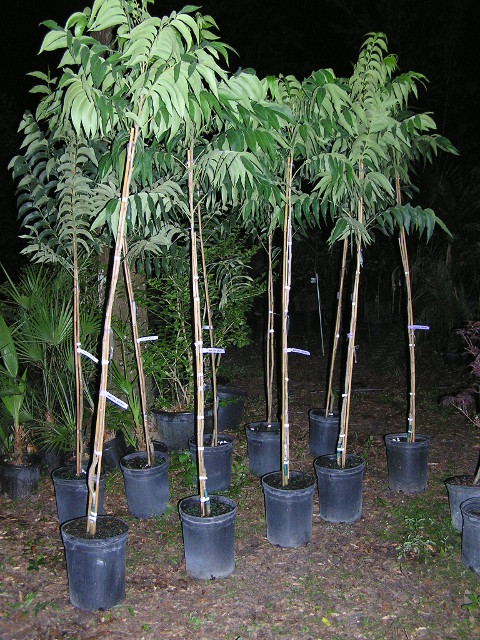
young 5gal pecan nut trees: extra tall !
Soil & Site Requirements
Pecans need deep, fertile and well drained soil with substantial water-holding capacity. Pecans generally like a slightly acidic pH between 5.5 to 7 pH.
They need at least 3 feet of well-drained soil above the minimum depth of the water table in order to develop a strong root system. They like lots of water, but not standing water -- the planting site must drain.
Peat moss is a good additive to help amend our sandy soils and provide moisture retention without changing the pH of the soil. But only if you have NO clay underneath. If you have clay a few feet down, skip the peat moss, as the clay should provide adequate water retention above.
The planting site should be at least 30' from any buildings, other big trees or power lines. It should be in full sun and provide good drainage. Pecan trees should be planted 40-50' apart if planting near to each other. Trees should also be at least 15' from driveways or roads to allow moisture and air to reach the roots.
Choosing Your Tree
Pecans have actually only been cultivated as grafted trees for about the last 150 years. Seedling trees will take 20-25 years to produce and usually don't produce quality nuts, compared to what we've become accustomed to in grafted cultivars. So make sure you're choosing a grafted tree if you expect nuts before your grandchildren have grandchildren.
Next, bare root trees have a much higher mortality rate than potted trees, so know this if you choose to buy bare root. Container grown trees can easily cramp the tap root, so the new method of container growing is either "grow sleeves": tall slender fabric pots that provide space for the tap root to stretch out, or simply taller / skinny nursery pots.
A cramped tap root needs to be gently untangled as you plant the tree to avoid either growth issues or wind damage issues in the mature tree.
A 5-gallon tree is typically 3-5' tall w/ 1/2"-5/8" calipers and a 7-gallon tree (when available) is typically 6-7' tall w/ 3/4" - 1" calipers. Typically a 5gal size will start bearing nuts in 5-7yrs, and a 7gal size will start about a year earlier. Trees that are between 3-7' tall have the highest success rate for transplanting and experience the least shock.
Think smaller when choosing your pecan!
For the 'techies' among us
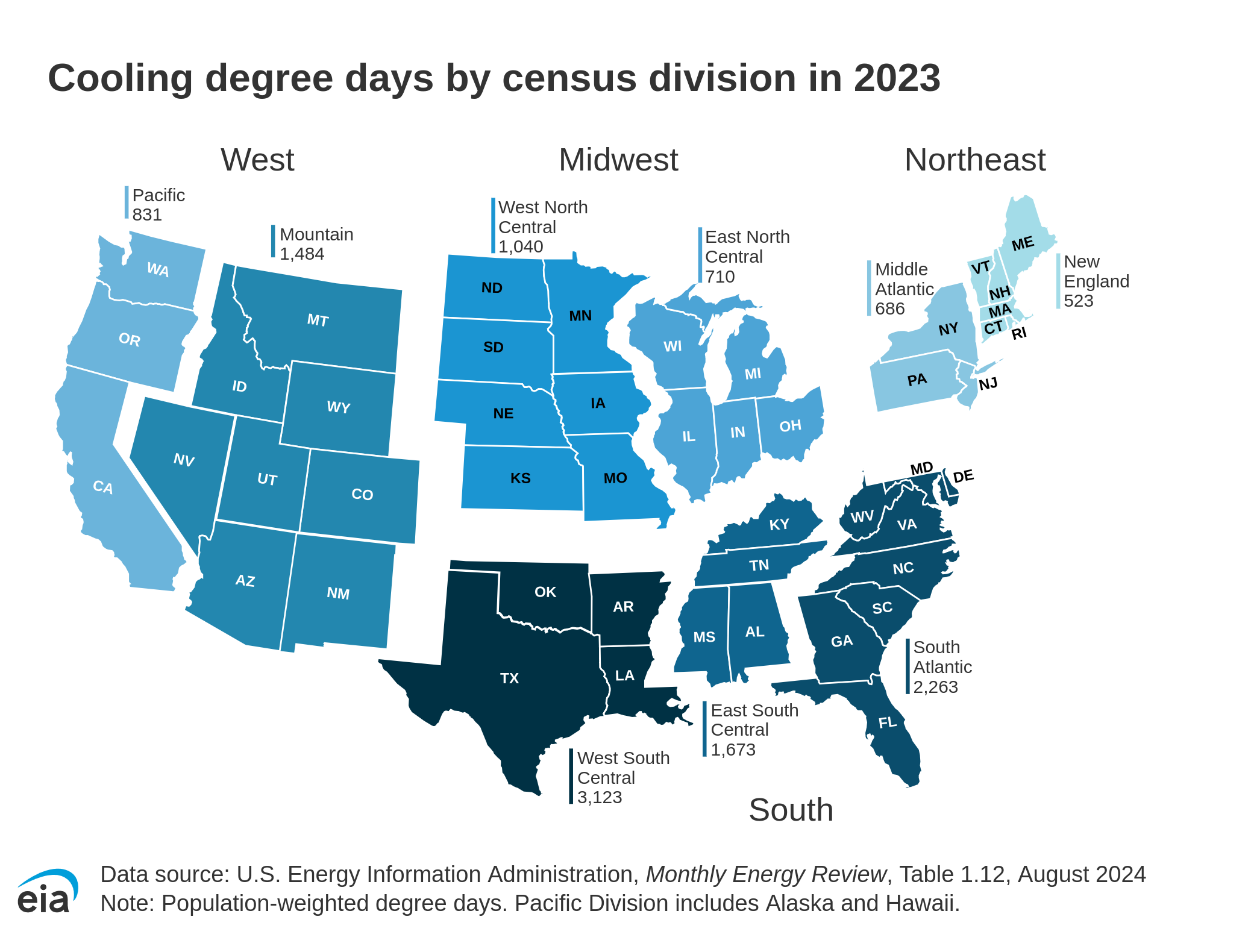
Pecans need at least 180 days of frost free growing with temperatures above 28°F, combined with at least 950 'cooling degree days' (a measure of summer heat and the demand for air conditioning), to properly grow and mature a nut crop.
So what's a 'cooling degree day' and why are they more than the number of days in a year?
A cooling degree day is a measure of how hot the temperature was on a given day compared to a standard temp., usually 65° F in the US. In other words, how much a/c will you need !
Read more here & check out the map to the left.

Pecans are pollinated by the wind.
Planting Your Tree
Pecans are wind-pollinated and can cross-pollinate up to one mile away. Some sources say within 300 feet of another variety is a better bet to ensure thorough pollination.
Bare root trees can only be planted from December to late February. However, container-grown trees can be planted anytime of the year, as long as they are kept watered, though avoiding the deep heat of summer (June, July, early August) is certainly easier on both the trees and the gardener.
Dig the hole about the same depth as the tap root and root system and no deeper. You don't want the pecan tree to "settle" deeper into the hole, as it is sensitive to proper planting depth. Plant trees at the same depth at which they grew in the nursery.
Dig the hole about 3-5' wide to leave room for filling in with loamy soil amendments. Pecans love rich, fertile humus so amending your soil with good composted top soil is excellent. But remember to only add peat to retain moisture IF your site has sandy soil underneath. If you have clay, you don't want to retain that much more water or you'll make it too soggy.
It is extremely important to pack the soil around the roots as you re-fill the hole, to eliminate any air pockets around the roots. This is most easily done by watering in the dirt as you fill the hole. Thoroughly water the trees after planting with at least 5 gallons of water.
It is also helpful to build a saucer of dirt around the trees approximately 3-5' in diameter to help with holding the water near the tree as it soaks into the ground. This is one of the few trees in Florida that we recommend using the moat approach to watering, and it only works if you have clay or added peat to assist with holding water. Remember, the native environment of the pecan tree is the rich flood plains of the Central United States.
Bareroot trees must be cut back by about one-half at planting time to balance the shock of transplanting. Container grown trees do not need to be cut back as a rule.
Pruning
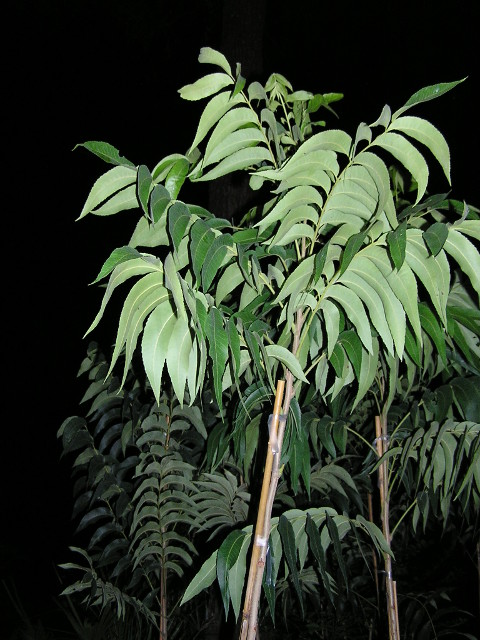
When planting a 6-7' tall specimen, you probably already have an almost straight trunk and very little branching, except at the top. You want to end up with a strong, single vertical trunk at least 6' tall.
Permanent branches are developed at the 6' height and up. Should you need to prune branches early on, the goal is to leave branches with wide crotch angles between 45 and 90 degrees.
Severely topping a large healthy tree is not recommended for the home orchard environment. It ruins the tree's looks and can allow insect and disease entry to the tree. New branches that form after topping usually have narrow branching angles and are more easily split out in future years. An exception to this rule of thumb is the farmer who practices "hedge pruning" on his pecans to increase yields in the large orchard. It helps with the shading from the next row of trees. See Univ of GA for more info.

Fertilizing
Young pecans love a good nitrogen based fertilizer in frequent small amounts. It's hard to go wrong using our Magic Mix Formula with organic composted chicken manure, because it enhances nitrogen fixation in the soil. For our sandy soils in North and Central Florida, applying once per month from mid/late February through Sept / Oct is a good practice.
Pecans also benefit from additional zinc. The greensand in our Magic Soil Formula is an excellent source of trace minerals for the pecans, but it may be necessary in some areas to add more zinc.
Watering
Irrigation is essential for survival and rapid growth of the young trees. Pecans can grow as much as 25 feet in the first 7 years! Like all fruiting trees, pecans should have water every single day if you live in sandy Florida. Don't let them experience drought if you want food.
The root system is at least two times the width of the tree canopy, so water the entire root soil area to be sure the feeder roots are getting a drink.
Keep the grass and weeds out of the watering saucer so that the tree gets all the nutrients and water and not the grass.
Insects
Planting pecan varieties that are more resistant to pests is just the beginning to dealing with pests.
There's no sure fire way to avoid insects but organic practices will help attract the predators you need to manage the problem. Ladybugs, chameleons and praying mantis all help to eat the aphids that cause many problems for pecans.
Use the Texas Red Cedar oil both topically and in the dirt will eliminate the majority of your pest problems before they start. Spraying your young trees every month or so the first year will help keep down insect larvae so your tree can get ahead of the pests.
Practicing organic soil amending will help you grow a strong tree with a strong immune system that is far less likely to attract significant numbers of pests as well. Remember that greensand (used in our Magic Mix formula) improves the plants' immune systems by the addition of trace minerals.