
Leaf Mining Insects
. . . are a large family of microscopic pests that destroy the new growth of the host plant. Most are actually the larvae of a moth.
There are thousands of different leaf miners, but there are at least 10 different families that are commonly found in the garden.
Larvae color ranges from white to light green with a black or brown head --- if you can see them. While it is a different species from the leaf miners that attack your tomatoes or the spinach, they all seem to proliferate the most when spring gets well underway. For us in Florida, that means May or maybe June.
Citrus Leaf Mining Insects
Citrus leaf miners are specific to citrus plants.
They are actually a moth: Phyllocnistis citrella.
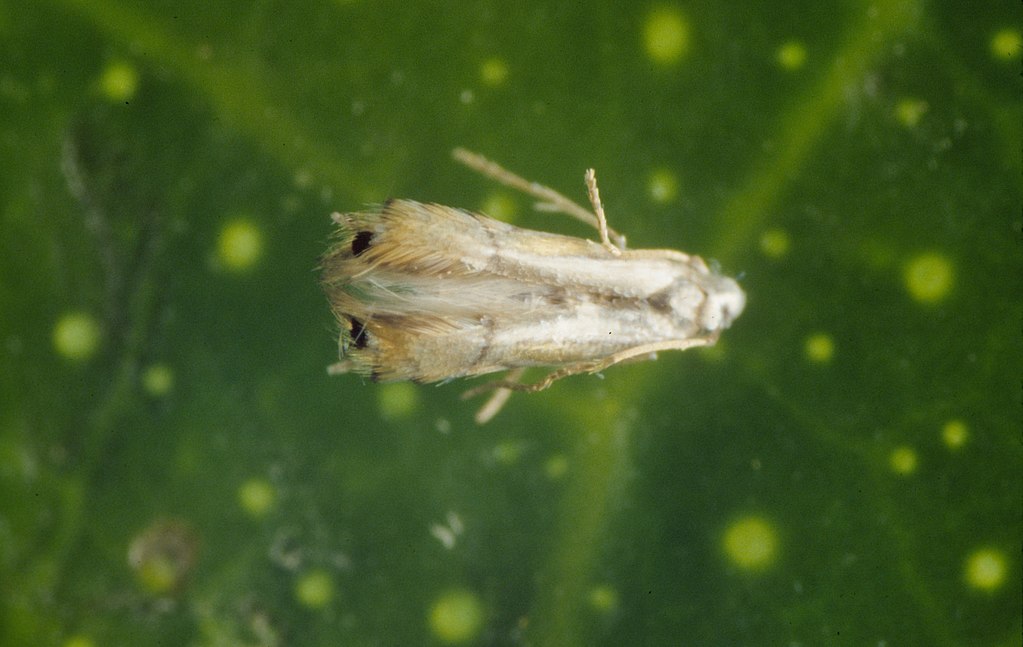
adult citrus leaf miner moth
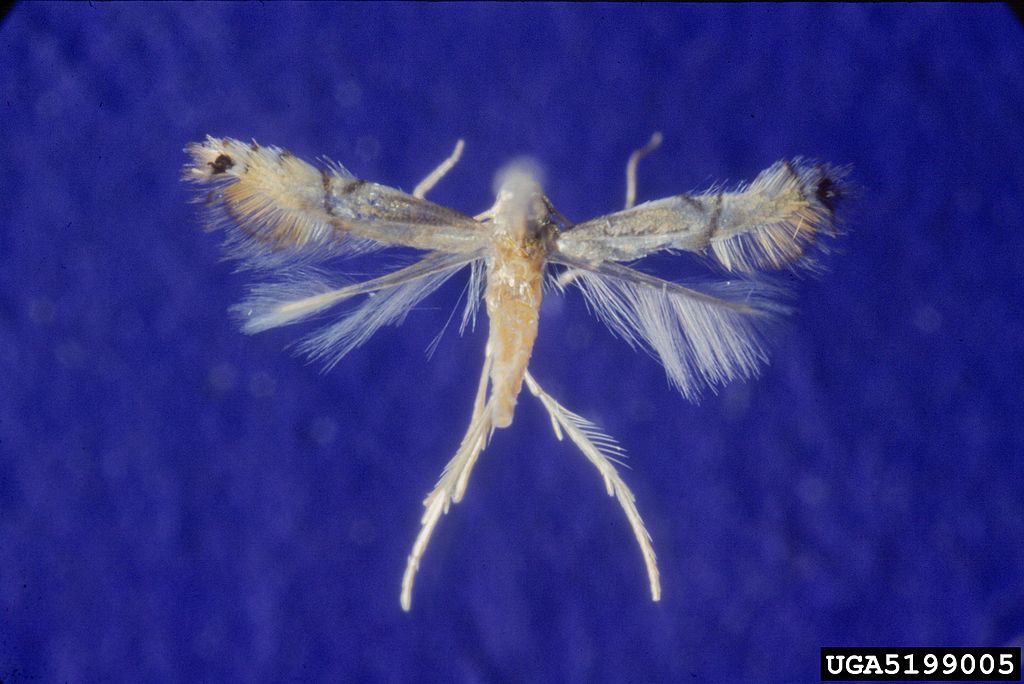
adult citrus leaf miner moth with wings extended
above photos courtesy of The Bugwood Network at the University of Georgia and the USDA Forest Service (link)
Understanding the life cycle is the key to knowing when to spray and / or why it's not working. The Texas cedar oil product you've all heard us promote is very effective at eliminating this pest, but must be used more than once to break the life cycle of this pest.
Here's a few facts worth noting on the life cycle of citrus leaf miners:
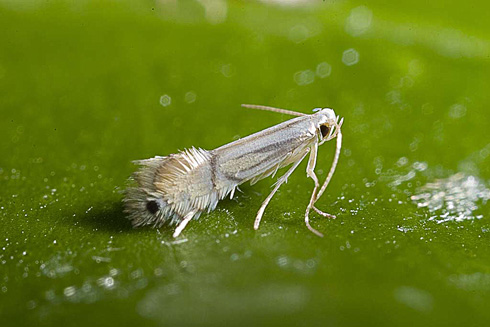
Citrus leafminer adult moth.
Originally from Asia, the citrus leaf miner was first found in the USA in 1993 and quickly spread to Texas, California and beyond.
It was first found in Australia in 1995.
Larvae have been found on citrus as well as other species such as Garcinia mangostana, and Jasminum sambac to name a few.
Female adult leaf miners lay eggs mostly on the tender new growth in the spring (in Florida), but sometimes arrive in the fall too. They can actually inject the eggs into the leaf's skin --- up to 250 eggs at one time.
As the weather warms, the eggs hatch: the egg stage lasts about 10 days.
As the larvae hatches, they tunnel through the leaf tissue eating all the nutrition, leaving a destructive white trail in their wake. They are literally INSIDE the leaf tissue.
After about 10 days, they chew to the surface, drop onto the ground, and burrow in about an inch or two below the surface.
If the weather is too cold, they hibernate in the dirt till spring. If the weather is warm enough, they mature into adults right away. That process takes about 15 days. At which point they emerge from the ground, fly to the leaves and lay more eggs!
Larvae does the damage.
What you see on the leaf is actually the larvae crawling around inside the leaf tissue, eating the leaf from the inside out.
It causes the new growth to twist and curl and prevents it from fully expanding, and retarding growth.
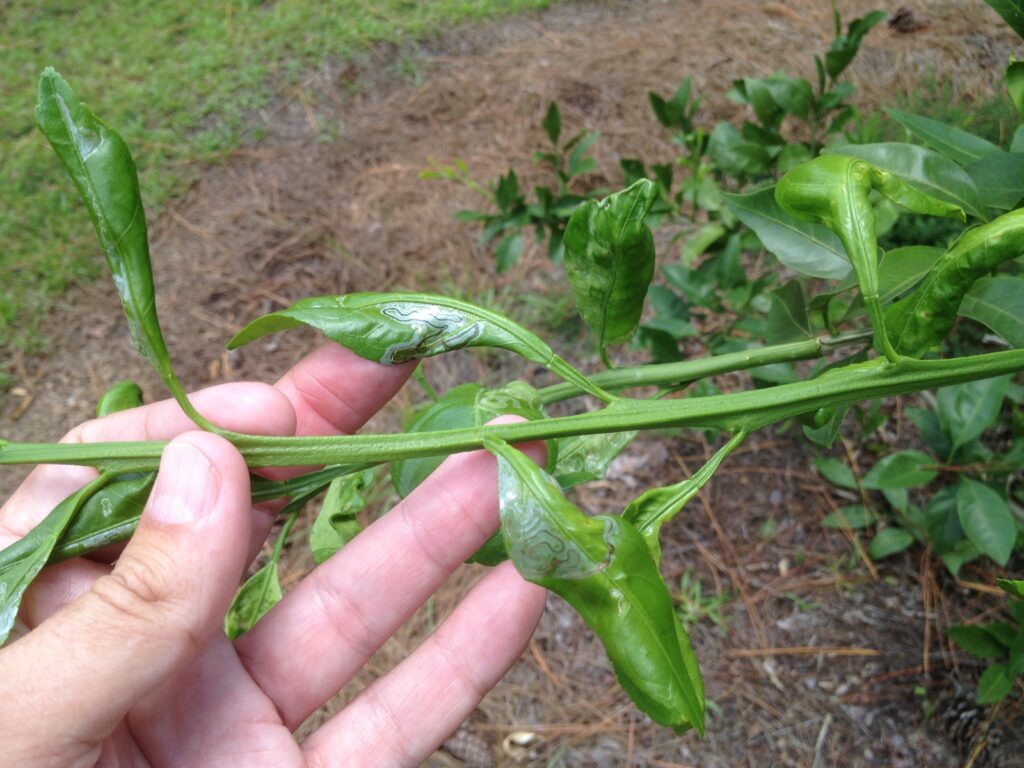
Photo: Jake Price, UGA Extension, Lowndes County
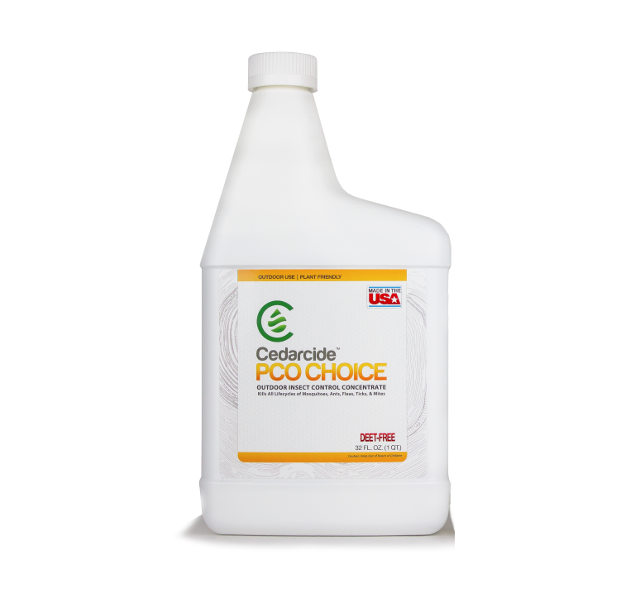
cedar oil made from the Texas red cedar plant contains special compounds for the best bug control
How to treat
In Florida, a new generation of the citrus leaf miner is produced every three weeks.
So treating the dirt simultaneous to treating the leaves is absolutely essential.
Removing any affected foliage and burning it is also essential. Theoretically, one must spray the remaining foliage daily for a minimum of ten days to prevent the larvae that are inside the leaves from emerging, dropping to the ground, and re-infecting the tree. Using the cedar oil is more efficient than using even Neem oil, because it can be used to treat the soil as well. It also kills more kinds of fungi than neem will.
2022 is our second consecutive year seeing a major infestation of these citrus leaf miners in our area. We are finding that a daily spraying with the cedar oil for a solid two weeks is what it takes to get us past a major infestation. And treating any new product that enters the nursery immediately is also essential: spraying the dirt to kill the pupa before it metamorphoses into an adult.
Click the image to the left to read more on the correct formula of cedar oil for maximum bug control on plant life.
